Dare to Care: Can High Performance and Psychological Safety Co-Exist?
Angela Lane & Sergey Gorbatov
The world is full of dichotomies that seem to contradict each other, so we feel compelled to choose one or the other. But two seemingly contradictory things can be true.
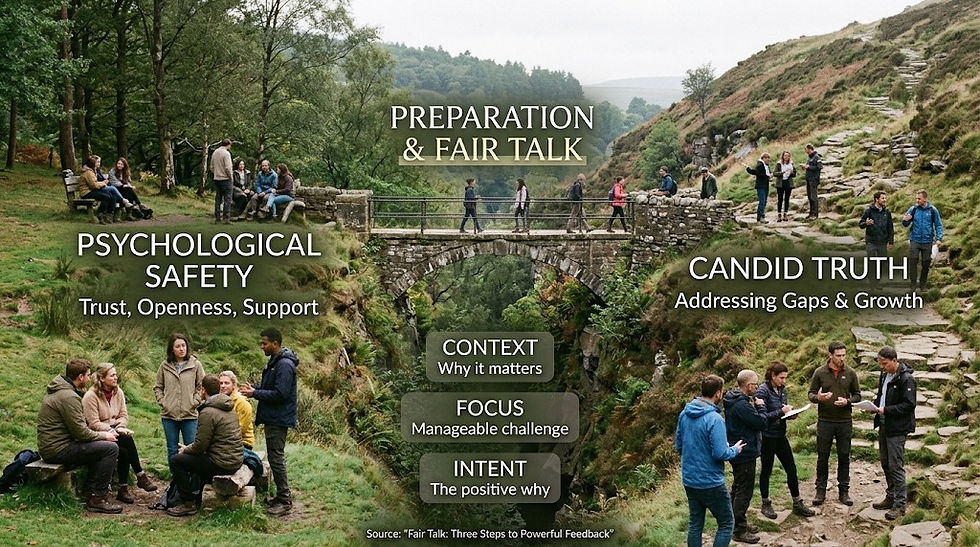
The first: the best leaders build psychological safety. They create environments where people can speak up, disagree, ask for help, and admit mistakes without fear. Amy Edmondson’s research settled this years ago: safe teams innovate more, include more, and perform better. Organizations responded by teaching the behaviours that build safety: don’t blame, listen well, don’t trade in negativity, be vulnerable and more.
The second: the best leaders tell people the truth. Unfiltered and unvarnished. Clear and unequivocal. High-performing teams are built on candour about gaps: in skills, behaviours, and results. Clearly naming a development opportunity and setting the expectation that someone close to it is one of the few real levers a leader has.
And herein lies the friction. The leadership behaviours that feel like they create safety sit awkwardly next to an approach that calls for the leader to consistently look for, and call out, gaps.
So leaders face a tension.
But it doesn’t have to be win/lose. If you prepare for it.
Even in a neutral setting, people protect their self-image. And the workplace is not neutral. Hierarchy, expert status, power dynamics, established networks… tilt the field before anyone speaks. Some groups, women and minorities among them, carry more of that risk than others. When even honest feedback lands on top of this, the changes are that the environment will feel less safe. It is a reasonable operating assumption for a leader.
The temptation is to say nothing or retreat into praise. Recognition is easier to give and supports a positive environment, which is the best environment for learning, after all.
But as a development strategy, it takes a leader only so far. Because the feedback that shifts performance is feedback on the biggest weakness (gap, opportunity, growth area…). Praise, on its own, won’t improve performance; in fact, a steady diet of one-sided positive feedback teaches people to stop processing their gaps at all. Over time, employees may actually lose the ability to course-correct. We have low self-awareness to begin with. Unbroken praise makes it lower.
So what to do?
In our book “Fair Talk: Three Steps to Powerful Feedback”, we see three predictable ways the ego defends itself against negative feedback. Leaders who anticipate these responses can protect safety without softening the point.
Saving face
Criticism stings. It embarrasses us. It leaves a bruise. A leader can take the edge off feedback by giving it context. We call this “tell me why it matters”.
When you explain why the issue matters, you are also telling me that my contribution counts and my work is important. This protects the ego while still getting the job done.
Keeping perspective
Another instinct is to lose proportion. Feedback receivers catastrophise. Based on the feedback, they retreat to “I’ll never be any good” and “I can’t get anything right.”
All-or-nothing thinking turns one piece of advice into a verdict. A powerless team member is the opposite of what we need.
The skill here is to rightsize the challenge. We recommend giving feedback on one manageable thing. If the meeting went badly, in a hundred ways, in part because of how it was structured, give clear and unequivocal feedback on the meeting structure. Achievable beats overwhelming, every time.
Managing projection
Faced with a clear message, receivers sometimes shoot the messenger. They decide the leader “doesn’t like me”. Feedback is actually hard to give. Mostly, it’s given when we care about the person, the outcome, or both.
So, say so.
When leaders are explicit about their intent, “I’m telling you this because I want you to be better, and I think you can”, it helps.
There is a reframe we teach leaders that disarms the common defences from those looking to shoot the messenger. "I knew you would say that." If the receiver believes the feedback is predictable, congratulate them. It means it’s confirming. If it is confirmed, why not work on it? If shooting the messages sounds like “no one ever told me that before”, we suggest you congratulate them. It’s an insight. Which means it’s useful and you should work on it.
Either way, the answer is the same. Work on it.
None of this is soft. It is the opposite of soft. It is how you tell the truth without breaking the trust that people need to feel safe.
So if you lead a team, prepare your feedback. Psychological safety matters. And so does development. They are at odds if you give feedback when you aren’t ready. Anticipate the three responses. Respect each person's ego, while staying honest.
Giving feedback well is a learnable skill. Build the skills in yourself. Build them in your team, if they lead others. Get the benefits of a safe team without starving team members of the feedback they depend on for growth.
Safety isn’t the absence of hard messages. It’s the presence of preparation.
Disclaimer: the opinions expressed here are the authors’ and don’t represent the opinions of any other organisation or institution.


Comments